Talos
Talos is an agentic codebase peer-reviewer with general-purpose AI assistant functionality, written in C++.
The project is currently in pre-alpha. It has been tested with an AMD GPU on Debian 12 using the X11 protocol.
Overview
Talos is designed around the idea that AI should improve how you code rather than simply code for you.
The project combines codebase-aware peer review with conversational AI, speech interaction, and screen-reading capabilities. At present, these systems are still partially separated, but the long-term goal is to make voice the primary interaction mechanism for an agent that can understand both a codebase and what is happening on screen.
Talos began as an R&D prototype for exploring a full voice-driven interaction system intended for integration into QuestFarer.
Current Capabilities
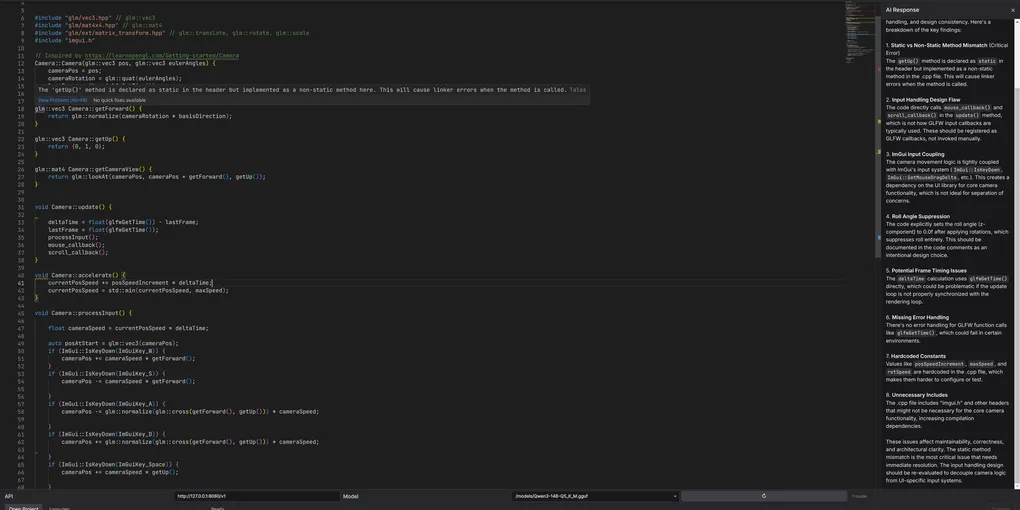
- Agentic codebase peer review
- Codebase-aware questioning
- General-purpose LLM conversation
- Local text-to-speech
- Local speech-to-text
- Screen-region capture and OCR
- Wake-word detection
- Support for local or remote OpenAI-compatible LLM endpoints
Codebase Reviewer
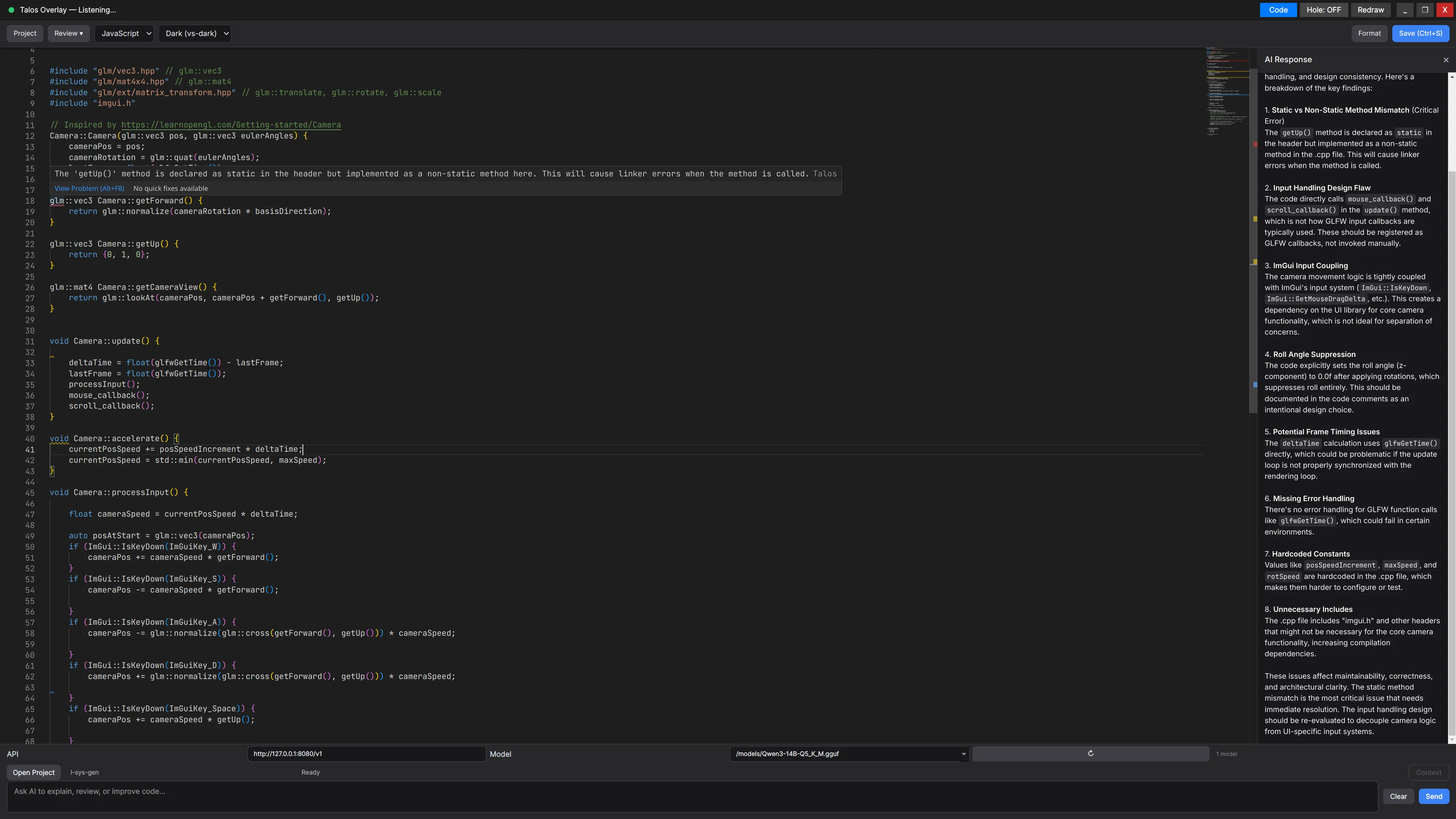
The core of Talos is its codebase peer-review system.
Rather than requiring an entire repository to be loaded into the model, Talos uses a dynamic file-request system. The agent can begin with a single file and intelligently locate relevant dependencies as they become necessary.
This approach is intended to keep context usage efficient while allowing the reviewer to reason about code beyond the file initially presented to it.
Design Pillars
Talos deliberately takes a different approach from many popular generative AI coding tools:
- Improve how you code, rather than coding for you.
- Token-friendly dynamic file requests — review a single file without making assumptions about the rest of the project.
- Codebase-aware dependency discovery — the agent can intelligently locate files and dependencies relevant to its review.
- Local model support — run models locally for improved privacy and cost efficiency.
- OpenAI-compatible endpoints — connect Talos to compatible hosted or self-hosted LLM APIs.
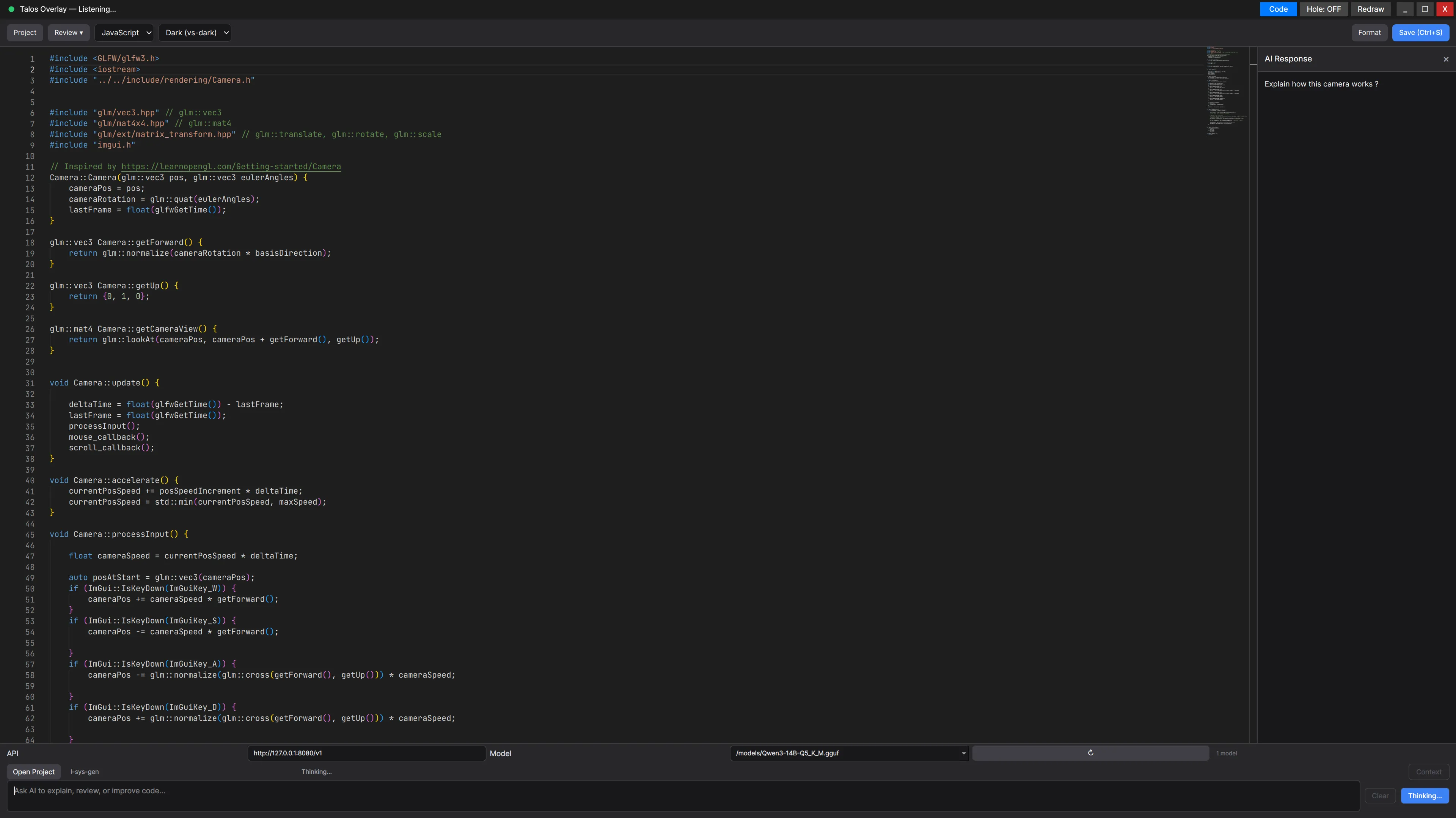
View the JSON format used for this response
Conversational Assistant
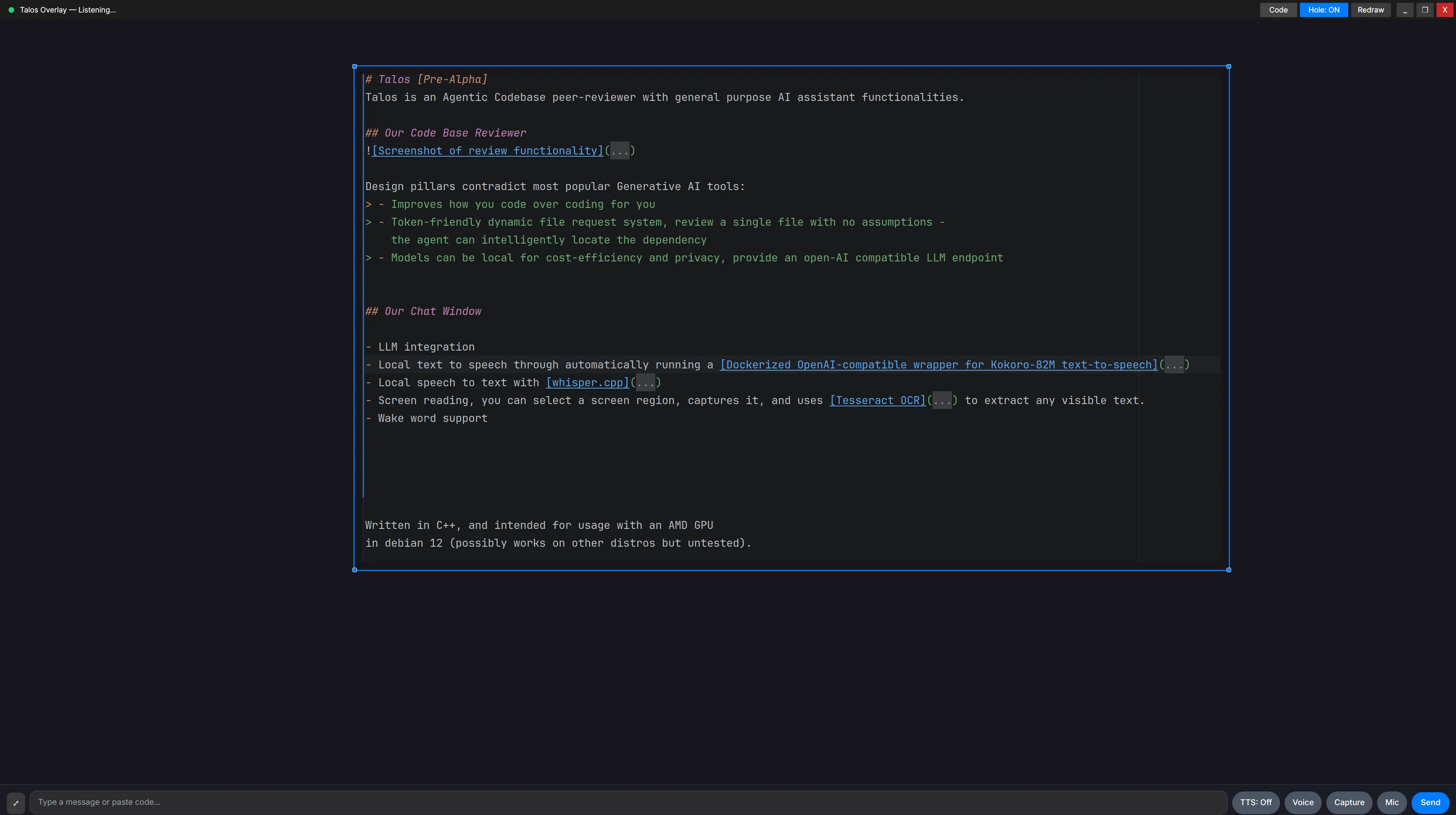
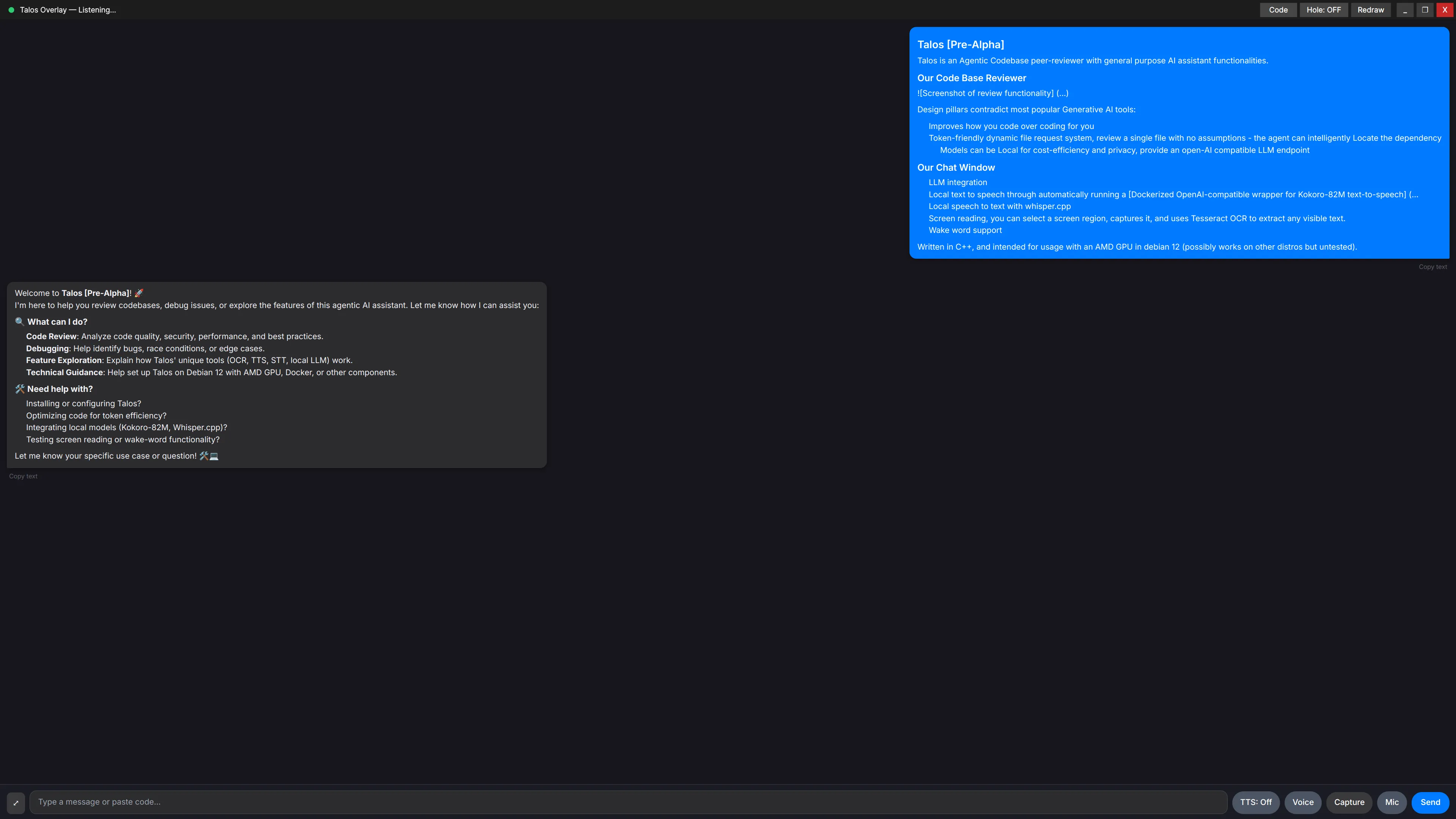
Talos also includes a general-purpose chat interface for interacting with an LLM.
The conversational functionality is currently separate from the code-review workflow, but the architecture is intended to evolve toward a more unified agent experience.
Voice Interaction
Voice is intended to become one of the primary ways of interacting with Talos.
The project currently includes both speech-to-text and text-to-speech capabilities, allowing the assistant to operate locally without requiring a cloud-based voice service.
Text-to-Speech
Talos can automatically run a Dockerized, OpenAI-compatible wrapper around Kokoro-82M for local text-to-speech.
Speech-to-Text
Speech recognition is handled locally using whisper.cpp.
Wake Word
Talos also supports wake-word detection using openWakeWord.
The current wake word is:
“Hey Jarvis”
Screen Reading
Talos includes an early implementation of screen-reading functionality.
The user can manually select a region of the screen, capture it, and pass the image through Tesseract OCR to extract visible text.
This functionality is currently manual, but the longer-term goal is to integrate screen understanding directly into Talos’s agentic workflows.
This would allow the assistant to reason not only about the codebase, but also about information visible elsewhere on the user’s screen.
Local AI & Privacy
A key design goal of Talos is the ability to use local AI models.
Rather than requiring a specific cloud provider, Talos is designed to communicate with OpenAI-compatible LLM endpoints. This allows the same interface to be used with local inference servers as well as hosted models.
This provides several advantages:
- Privacy — source code can remain on the local machine when using a local model.
- Cost efficiency — avoid API costs when running suitable models locally.
- Model flexibility — switch between compatible inference backends.
- Self-hosting — maintain greater control over the AI infrastructure.
Technology
Talos is primarily written in C++.
The current development environment has been tested with:
- Language: C++
- Operating System: Debian 12
- GPU: AMD
- Display Protocol: X11
- LLM: OpenAI-compatible endpoints
- Speech-to-Text: whisper.cpp
- Text-to-Speech: Kokoro-82M via Kokoro-FastAPI
- OCR: Tesseract
- Wake Word: openWakeWord
- Containerisation: Docker
Project Status
Talos is currently pre-alpha.
Many of the components are functional independently, but the larger vision is still under active development. In particular, conversational interaction, code review, voice control, and screen understanding are intended to become increasingly integrated.
The long-term goal is an assistant that can:
- Understand a codebase without requiring the entire repository to be placed into context.
- Review and question code while helping the developer improve their own programming.
- Interact naturally through voice.
- Understand relevant information visible on the user’s screen.
- Operate using local AI models where privacy, cost, or control are priorities.
Future Direction
The eventual Talos experience is intended to move beyond a conventional chat window.
The goal is a codebase-aware development agent that can move naturally between conversation, code review, voice interaction, and visual context.
Rather than replacing the developer, Talos is designed to act as a persistent peer reviewer and assistant — helping developers understand their own code, identify problems, and make better engineering decisions.